
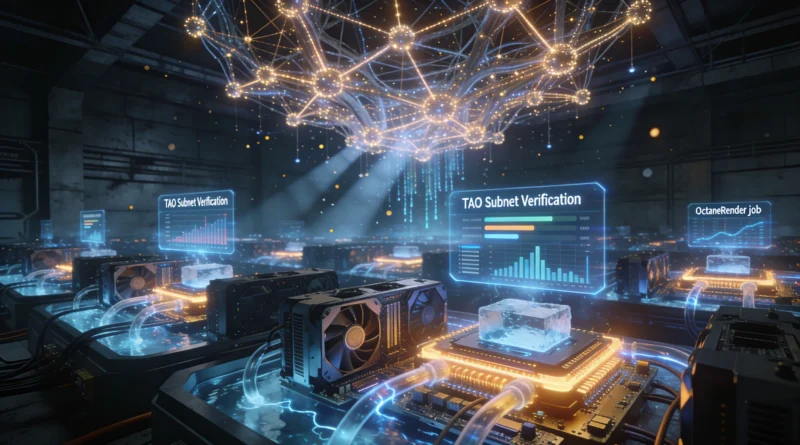
The AI Compute Revolution: Analyzing the Network Growth of Bittensor (TAO) and Render
The Shift from Speculation to Utility
In the current financial landscape, a significant divergence is taking place. While traditional digital assets often react to macroeconomic shifts and interest rate expectations, a specific sub-sector is beginning to decouple from the broader market: Decentralized AI Infrastructure.
This is not a temporary trend. It is the market beginning to price in what we call the “Silicon Whale.”
Investors are moving beyond the “Store of Value” narrative and are starting to treat decentralized compute power as a vital physical commodity. Here is why the infrastructure layer of AI is becoming the most resilient sector in the digital asset ecosystem.
The Great Decoupling: Compute Power vs. Market Volatility
For the first time in 2026, we are witnessing a clear separation of assets based on utility rather than sentiment. In periods of market uncertainty, capital is rotating aggressively into assets that provide the “fuel” for the artificial intelligence revolution.
Specifically, networks like Bittensor (TAO) and Render (RNDR) are showing remarkable strength even when traditional markets face a “risk-off” sentiment.
The data suggests a fundamental shift: AI compute is no longer a speculative bet; it is a physical necessity for the global economy. As traditional finance integrates AI into every layer of operation, the demand for decentralized, censorship-resistant compute power is becoming inelastic.
The Hardware Catalyst: Why Semiconductors Drive the Thesis
The strength of AI tokens is not driven by social media hype; it is anchored in the physical semiconductor supply chain.
Recent industry developments, such as the advancement in HBM4 memory chip shipments, serve as a massive catalyst for decentralized networks. HBM4 chips are the essential hardware required for high-performance AI agents and large language models (LLMs).
- The Hardware-Software Connection: Advanced chips allow for more complex AI agents.
- The Infrastructure Signal: As the hardware layer (Samsung, Nvidia) scales, the decentralized software and compute layers must scale to match it.
Institutional confidence in the infrastructure layer is reaching an all-time high. Analysts are increasingly recognizing that without decentralized compute networks, the AI revolution faces a massive bottleneck in centralized GPU supply.
The synergy between Nvidia’s Blackwell B200 architecture and decentralized rendering protocols has created a unique infrastructure arbitrage. As centralized data centers prioritize LLM training for hyperscalers, Render (RNDR) is effectively capturing the ‘overflow’ of spatial computing and creative rendering demand. In 2026, decentralized networks have become the global GPU safety valve, absorbing the compute requirements that traditional providers can no longer service due to their focus on enterprise-scale AI training.
The “Agentic Economy” Thesis
We are transitioning from an economy where humans are the primary consumers of digital assets to one where AI Autonomous Agents become the dominant participants.
An AI agent operates on logic and necessity, not on emotion or macroeconomic fear. To function, an autonomous agent requires two things:
- High-Quality Data: Facilitated by networks like Bittensor (TAO).
- GPU Processing Power: Facilitated by networks like Render (RNDR).
As the “Bot Economy” grows, the demand for these resources becomes constant. This creates a “Supply Shock” where the available compute power on decentralized networks is consumed faster than it can be provisioned. This fundamental demand is what allows the AI sector to hold its value even when other assets face volatility.
Comparative Analysis: Infrastructure Resilience
When we analyze the performance of AI-centric assets against traditional market benchmarks, the outperformance is statistically significant.
While broader markets may struggle with interest rate uncertainty, assets like Fetch.ai (FET) and Render maintain stability. This is because their value is tied to the expansion of AI capabilities—a trend that continues regardless of the Federal Reserve’s decisions.
However, this decentralized model is not without systemic friction. Throughout early 2026, Bittensor (TAO) faced significant challenges regarding ‘Subnet Pollution,’ where low-quality miners attempted to exploit incentive mechanisms with synthetic data. Similarly, Render continues to address latency bottlenecks when compared to the sub-millisecond response times of centralized cloud giants. For the infrastructure thesis to remain valid, these networks must continue to transition from experimental environments to enterprise-grade reliability before the 2027 hardware refresh cycle.
Table: Market Dynamics – Speculative vs. Infrastructure Assets
| Asset Category | Primary Value Driver | Reaction to Macro Volatility |
| Traditional Crypto | Market Sentiment / Liquidity | High Correlation (Risk-Off) |
| AI Infrastructure | GPU Demand / Network Growth | Low Correlation (Utility-Driven) |
| Semiconductor Stocks | Production Capacity | Moderate Sensitivity |
| Decentralized AI | Bot Consumption / Data Access | High Resilience |
Strategic Integration with RWA and Institutional Flows
This shift toward AI utility is closely linked to the tokenization of real-world assets (RWA). As we discussed in our recent analysis of institutional behavior, banks are no longer just looking at tokens; they are looking at the underlying rails of the future financial system.
[The Institutional Accumulation Phase: Analyzing Goldman Sachs’ Crypto Strategy in 2026]
Just as Goldman Sachs is positioning for a future of vertically integrated blockchain infrastructure, smart money is rotating into AI compute as the ultimate “safe haven” for the technological age.
My Personal Take
In my professional opinion, the AI sector represents the first true “industrial” phase of the digital asset market. We are moving away from the era of “memecoins” and moving into an era of “utility-coins.”
The charts are clear: when volatility hits, the assets with real-world utility like TAO and RNDR are the first to recover. This is not a coincidence; it is a signal.
I believe the “supply shock” for AI compute is imminent. Unlike traditional finance, which is slowly accumulating digital assets for custody, AI agents are buying compute power right now to function. The next major market expansion will not be led by human speculation; it will be led by the machine-to-machine economy.
The resilience of compute-backed assets is also reshaping our evaluation of Layer 1 performance. As we analyzed in our deep dive into Monad vs. Berachain: A Technical Comparison of Parallel EVM and Proof of Liquidity in 2026, the networks capable of processing these machine-to-machine transactions with the lowest latency will be the ultimate beneficiaries of the AI compute surge. The convergence of high-performance execution and decentralized compute is no longer a theory; it is the fundamental architecture of the 2026 digital economy.
Positioning in the infrastructure layer today is akin to owning the electricity grid at the start of the industrial revolution.