NVIDIA vs. DePIN: Why Holding Stock is a 2024 Strategy (The 2026 Pivot)
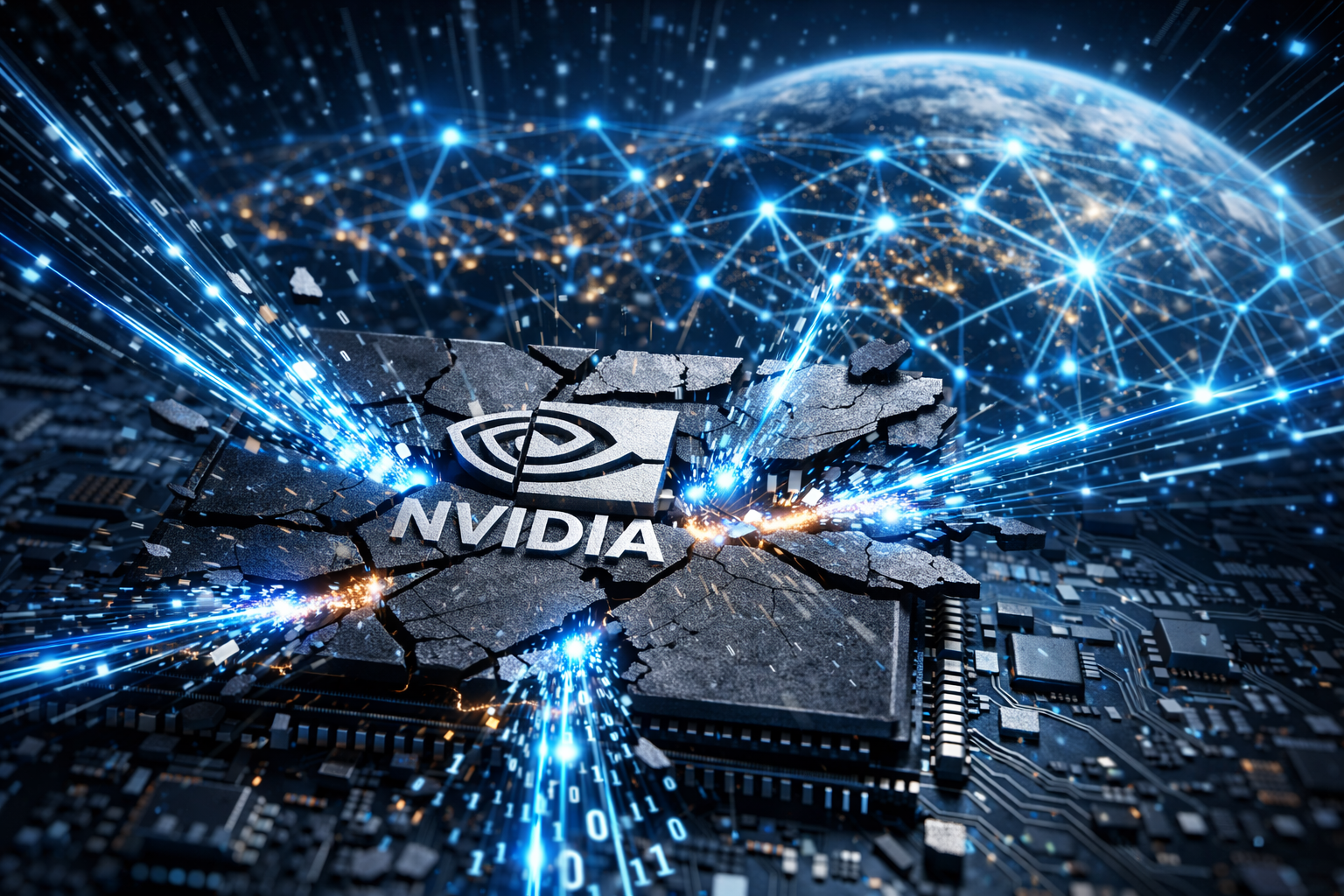
The AI gold rush of 2024 was defined by a single name: NVIDIA. However, as we navigate the complex financial landscape of 2026, the narrative has fundamentally shifted. While retail investors and “legacy” funds are still clinging to NVDA stock, hoping to replicate the 1,000% gains of the past, the smart money has moved toward DePIN (Decentralized Physical Infrastructure Networks).
The question is no longer who manufactures the chips, but who controls the access to the compute power. In 2026, owning hardware has become a commodity; owning the network is the ultimate alpha.
1. The Hardware Trap: The Paradox of NVIDIA’s Success
NVIDIA is, ironically, a victim of its own success. In its latest February 2026 earnings report, the company posted a staggering $68.1 billion in quarterly revenue, up 73% year-over-year. While these numbers are historic, they reveal a mathematical reality: the room for exponential growth is shrinking as the company’s market cap rivals the GDP of major nations.
In 2026, the bottleneck is no longer the production of the H100 or the new Rubin architecture chips. The real constraint is the centralized gatekeeping of that power. Companies like AWS, Google, and Microsoft have cornered the market, creating what we now call the “Compute Monopoly.” For a startup or an AI researcher in 2026, renting a cluster of GPUs from a centralized provider is a death sentence for their margins. You aren’t just paying for the silicon; you are paying for the corporate overhead of a trillion-dollar giant.
Investment ROI Comparison: 2026 Market Pulse
| Asset Class | Expected Alpha (2026) | Primary Risk | Market Role |
| NVIDIA (Stock) | Moderate (Post-Rubin) | Anti-trust / Valuation Saturation | Market Anchor |
| DePIN Protocols | High (5x – 10x) | Network Adoption / Liquidity | Infrastructure Disruptor |
| Cloud Providers | Low (5-8%) | Hardware Obsolescence | Legacy Gatekeepers |
| Compute RWAs | Stable (20-30%) | Oracle Failure | Strategic Hedge |
Analyst’s Take: Buying NVIDIA stock today is like buying shares in oil companies when electric motors already exist. It is a “safe” bet, but the real wealth generation has migrated to the protocols that allow anyone with an NVIDIA chip to plug their power into a global network without asking for permission.
2. DePIN: The Uber-ization of GPU Power
The rise of decentralized protocols has created a global, permissionless marketplace for compute. If you want to understand the fundamental mechanics of this shift, you should check our previous analysis on What Is DePIN? How AI and Blockchain Are Merging.
In 2026, we are witnessing the “Uber-ization” of AI. Instead of building massive, multi-billion-dollar data centers that take years to complete, DePIN leverages hardware already distributed across the globe. This isn’t just a theory; it is a direct threat to the NVIDIA AI Enterprise margins.
Why would a developer pay $4.50 per hour for a GPU on AWS when they can get the same compute for $1.80 on a decentralized network like Akash or Render? The math is undeniable. In 2026, capital follows the path of least resistance and highest efficiency.
3. The Energy Bottleneck: Why Centralized AI is Hitting a Wall
Centralized data centers in 2026 are facing a crisis that NVIDIA stock cannot solve: Power Grid Saturation. While NVIDIA continues to design more efficient chips, a centralized facility in Virginia or Dublin cannot simply “create” more electricity.
This is where DePIN wins. By distributing the compute load across thousands of individual nodes globally, DePIN bypasses the local grid constraints that are currently stalling the expansion of Google and Azure. We are no longer just in a “chip war”; we are in an “energy distribution war.” As we explored in our report on Goldman Sachs’ $2.3B Crypto Roadmap, the infrastructure that solves the energy problem will capture the most value in the next decade.
4. Psychological Warfare: Avoiding the “Hardware Bagholder” Syndrome
The most common mistake in 2026 is Recency Bias. Just because NVIDIA performed like a god in 2024 doesn’t mean it will do the same today. The “Psychology of Trading” teaches us that investors often stay too long at the party, blinded by past performance. When everyone at a dinner party is talking about a stock, the real alpha has already vanished.
We are entering a phase where people are still skeptical of DePIN. They claim it is “too complex” or “lacks stability.” As a critical analyst, I’ll tell you: that skepticism is your profit margin. By the time your traditional broker offers a “DePIN ETF,” the 10x opportunity will be gone. Don’t be the investor left holding Nokia stock when the iPhone launched. NVIDIA built the hardware that enabled the “AI iPhone” moment, but the value is now migrating to the network layer.
5. Regulatory Compliance: The 1099-DA Factor in 2026
Even in the decentralized space, you cannot escape the “taxman.” As of early 2026, the implementation of the IRS Form 1099-DA has fundamentally changed how we report digital asset proceeds. Whether you are earning rewards from providing compute power to Akash or staking in a DePIN protocol, every transaction is now under the microscope.
Wealth protection in 2026 is 50% strategy and 50% legal defense.
- Proceeds vs. Basis: For the 2025 tax year (filed in 2026), brokers are reporting gross proceeds.
- Cost Basis Reporting: Starting in 2026, full cost-basis tracking becomes mandatory for covered assets. If your portfolio is 100% exposed to legacy equities, your reporting is simple but your growth is capped. If you pivot to DePIN, you must use platforms that integrate these new asset classes into a compliant framework.
6. FAQ: Common Questions on the DePIN Transition
Is DePIN more risky than holding NVDA stock? Technically, yes. You are trading the market-cap stability of a trillion-dollar giant for protocol and smart-contract risk. However, the risk of “stagnation” in legacy stocks is often underestimated. In 2026, the risk of missing the next infrastructure cycle is greater than the risk of protocol volatility for a diversified portfolio.
How do I earn from DePIN without technical knowledge? The 2026 ecosystem has introduced “Compute Vaults.” These allow you to provide liquidity to protocols that fund hardware for professional operators. You earn a share of the network revenue without having to manage a single GPU cluster yourself.
Can DePIN networks actually compete with AWS in terms of uptime? While centralized providers offer 99.99% SLAs, DePIN networks like Render have achieved comparable reliability through redundancy. If one node goes offline, the task is automatically reassigned to another node in the global mesh.
Final Verdict: The 2026 Hardware Flip
Most investors will be late to DePIN, just as they were late to Bitcoin in 2015 or NVIDIA in 2020. They are too busy staring at the Wall Street ticker while the world’s true computational power is migrating to the blockchain.
In 2026, power does not belong to the one who manufactures the pickaxe and shovel (NVIDIA); it belongs to the one who owns the network where those tools are used to mine the “AI Gold.” If you do not have exposure to DePIN, you are not investing in the future you are paying for the past.
Key Takeaways for the 2026 Investor
- NVIDIA is an Anchor, not a Rocket: Use it for stability, but look elsewhere for growth.
- Network over Silicon: The value has shifted from the chip to the permissionless access to that chip.
- Compliance is Non-Negotiable: Ensure your DePIN earnings are tracked for the 1099-DA era.