

The AI Defense Moat: A Strategic Analysis of Palantir’s Institutional Growth in 2026
Beyond the Hype: Palantir’s Transformation into Strategic AI Infrastructure
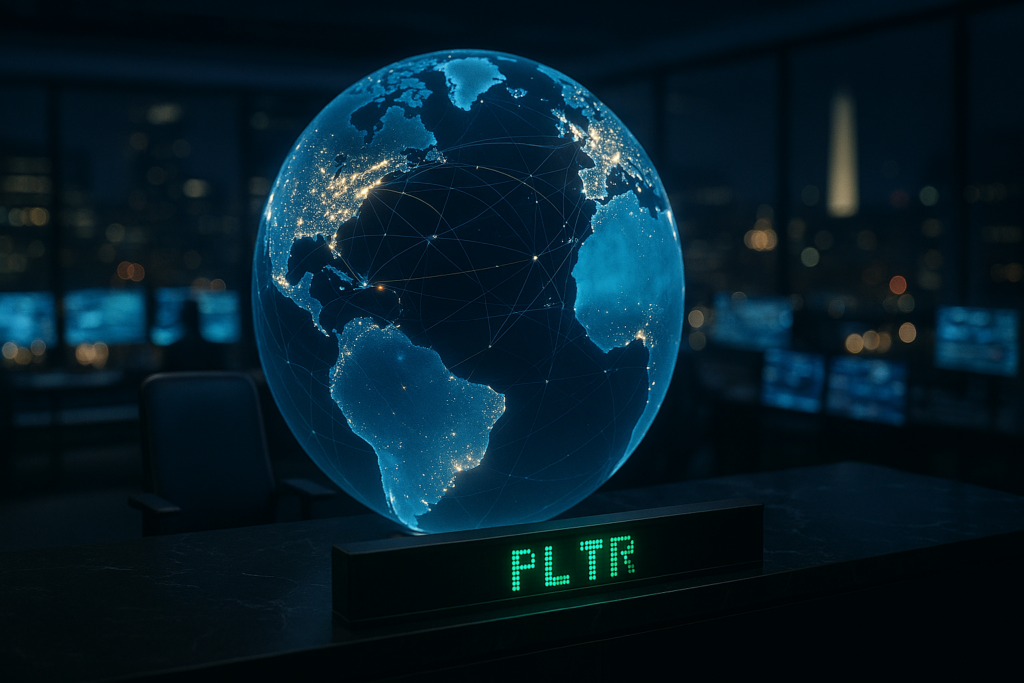
Palantir Technologies (NYSE: PLTR) has officially completed its transition from a specialized data analytics firm into a cornerstone of global AI defense infrastructure. Heading into 2026, the narrative surrounding the company has shifted fundamentally. We are no longer discussing a “controversial startup,” but rather a strategically vital entity that institutional investors are increasingly viewing as a mandatory holding for exposure to the “Execution Layer” of Artificial Intelligence.
The recent surge in institutional interest—often characterized as “Institutional FOMO”—is not merely a reaction to the AI hype cycle. It is the result of Palantir’s unique ability to secure and scale multi-year, high-budget defense contracts that competitors are currently unable to penetrate.
In this analysis, we will break down the structural “moats” Palantir has built, the reality of its financial evolution, and why the defense sector is the ultimate proving ground for long-term AI valuation.
The “Execution Layer”: Why Palantir Differs from Silicon Valley
To understand Palantir’s value, one must distinguish between “Generative AI” and “Decision Intelligence.” While much of the market remains fixated on large language models (LLMs) for consumer use, Palantir operates in the Execution Layer.
Their core platforms—Gotham, Foundry, and AIP—do not just generate text; they integrate fragmented data into a single, actionable “ontology.” This allows organizations to make mission-critical decisions in real-time under extreme pressure.
- Gotham: The backbone of modern battlefield intelligence and government logistics.
- Foundry: The commercial equivalent, transforming legacy industrial data into optimized supply chains.
- AIP (Artificial Intelligence Platform): The bridge that allows secure LLM integration within private, highly regulated environments.
The Defense Moat: Why Government Contracts Are “Sticky” Revenue
Institutional investors prioritize revenue visibility. Unlike SaaS companies that face high churn rates in a competitive economy, Palantir’s defense footprint is protected by massive barriers to entry.
Defense and intelligence contracts are inherently “sticky” for three reasons:
- Security Clearances & Trust: Palantir has spent over two decades achieving the highest levels of security accreditation (Impact Level 6). For a startup to displace them, they would need years of vetting that national security agencies are unwilling to risk.
- Embedded Workflows: Palantir’s software is not an “add-on”; it is the operating system for predictive logistics and threat detection. Removing it would require a total overhaul of agency infrastructure.
- The Scale of Modern Defense Budgets: As the U.S. and NATO allies accelerate spending on autonomous systems and cyber-defense, Palantir sits directly in the path of this capital flow. AI is no longer an “experiment” for the Pentagon; it is a requirement for tactical parity.
Institutional FOMO: From “Story Stock” to Financial Maturity
For years, the “Bear Case” against PLTR was built on three pillars: excessive stock-based compensation (SBC), lack of GAAP profitability, and a perceived “black box” business model.
In 2025 and 2026, the data has invalidated much of this critique. Palantir has demonstrated:
- GAAP Profitability: Sustained quarters of net income, leading to its inclusion in major indices.
- Operating Margin Expansion: The “AIP Bootcamps” have significantly reduced the cost of customer acquisition, allowing Palantir to scale commercial revenue faster than its internal costs.
- Free Cash Flow Strength: Providing the “dry powder” necessary for R&D without diluting shareholders at previous rates.
The “Silicon Whale” Effect: AI Adoption as a Necessity
Institutions understand that AI adoption in the public sector is becoming non-optional. In the current geopolitical climate, “Decision Speed” is the ultimate competitive advantage. This has created a “Silicon Whale” effect, where large-scale funds are accumulating PLTR not as a growth trade, but as a Strategic Hedge.
If you believe that the future of warfare and industrial logistics is AI-driven, Palantir is essentially the “toll booth” for that transition.
| Metric Type | Legacy Perspective | 2026 Institutional View |
| Valuation | “Overvalued” on P/E basis | Priced as Strategic Infrastructure |
| Customer Base | Over-reliant on Government | Diversified through Commercial AIP |
| Product | “Consultancy-heavy” | Scalable AI Platform (AIP) |
| Moat | Narrative-driven | Hardware-Software Integration |
Risks: The Price of Future Expectations
No institutional analysis is complete without acknowledging the “Bear Case.” Palantir’s primary risk remains its Valuation Sensitivity.
Because the market prices PLTR as the “standard” for AI execution, any deceleration in contract growth or a shift in government AI spending priorities could lead to significant volatility. Furthermore, while its “Impact Level” accreditations are a moat, they also limit the company’s total addressable market to allied nations and ethical commercial partners, creating a “geographic ceiling” that competitors in less-regulated markets might not face.
Final Verdict: The National Security Hedge
Institutional FOMO around Palantir is not rooted in the same “hype” that drives consumer AI startups. It is rooted in Fundamentals and Geopolitics.
Palantir (PLTR) has successfully positioned itself at the intersection of three massive secular trends: the modernization of global defense, the industrialization of AI, and the institutionalization of decentralized data.
As we move deeper into 2026, Palantir is no longer a “tech stock” to be traded on news cycles. It has become Core AI Infrastructure. For the big money on Wall Street, the risk of not owning the company that powers the decision-making of the world’s most powerful organizations is now greater than the risk of the valuation itself.