The AI Compute Revolution: Analyzing the Network Growth of Bittensor (TAO) and Render
Last Audit: March 3, 2026
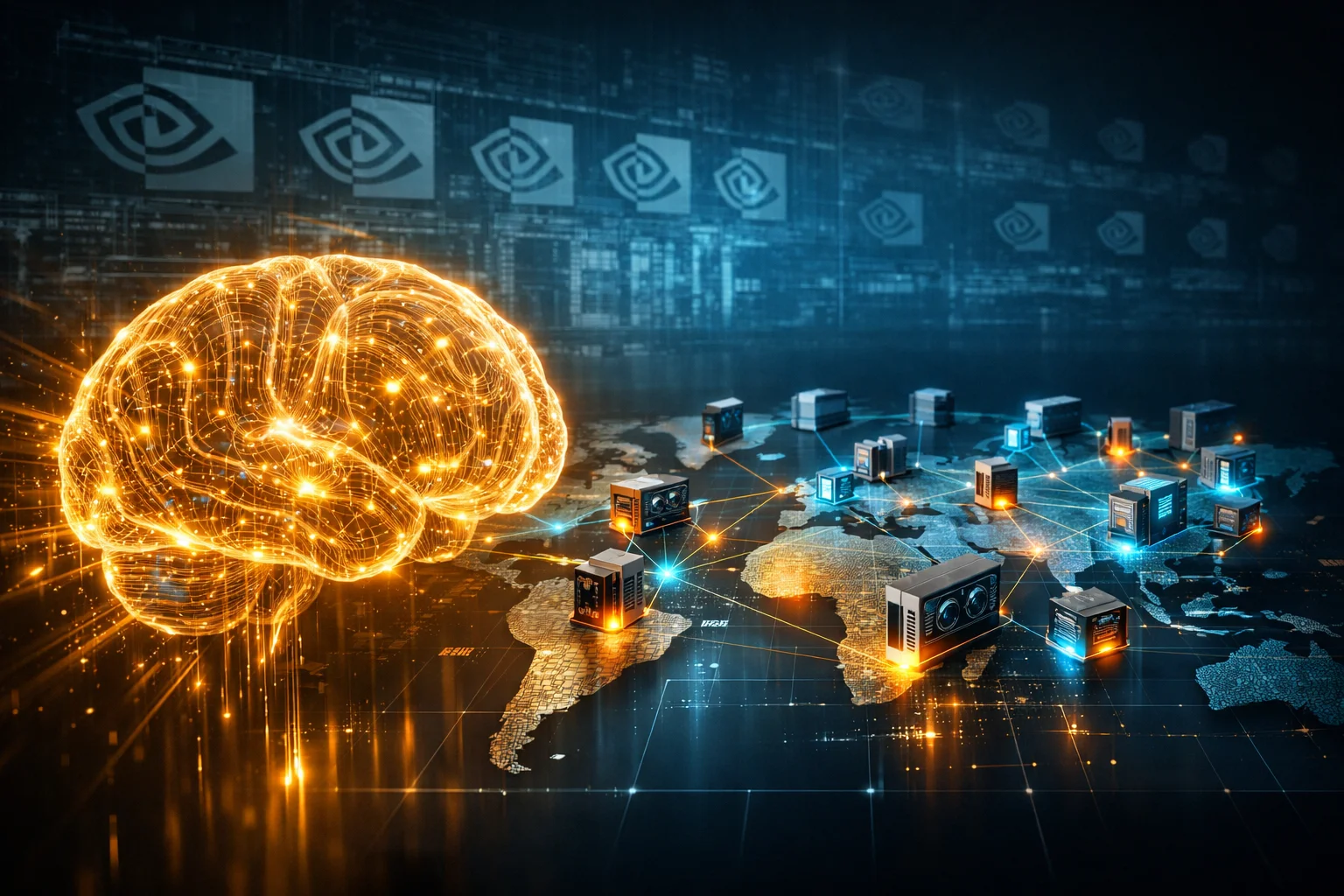
The “Silicon Whale”: Beyond the Speculative Bubble
For years, the digital asset market was driven by what we call “Human Emotion Cycles.” In 2026, those cycles are being replaced by “Machine Necessity Cycles.” While the broader market remains sensitive to the Federal Reserve’s interest rate pivots, the Decentralized AI Infrastructure (DePIN) sector has begun a structural decoupling.
This is not a trend; it is the emergence of the Silicon Whale. Institutional capital is no longer chasing “Store of Value” narratives alone. As we detailed in our Institutional Liquidity Series: Why Goldman Sachs is Accumulating Compute Rails in 2026, banks are now treating decentralized GPU compute power and neural network bandwidth as the new crude oil. As we transition into an agentic economy, owning TAO or RNDR is akin to owning a share of the global electricity grid in the 1920s.
1. The Great Decoupling: Compute Power as an Inelastic Commodity
In the first quarter of 2026, we have observed a statistical anomaly: when Bitcoin faces “Risk-Off” volatility, AI-centric assets like Bittensor (TAO) and Render (RNDR) maintain a lower correlation than ever before.
Why is this happening? The demand for AI compute is inelastic. An autonomous AI agent performing high-frequency arbitrage or a neural network training a new LLM (Large Language Model) cannot “wait” for the market to recover to purchase compute power. The machine-to-machine (M2M) economy requires constant, 24/7 uptime.
As traditional data centers (AWS, Google Cloud) face a 14-month backlog for H100 and B200 tensor cores, decentralized networks have become the Global GPU Safety Valve. They are no longer “alternatives”; they are the necessary overflow for a world that has run out of centralized silicon.
2. Bittensor (TAO): The “Neural Layer” and the Subnet War
Bittensor has evolved into the “World Brain,” but 2026 has brought its most significant challenge yet: Subnet Pollution.
The Forensic Reality
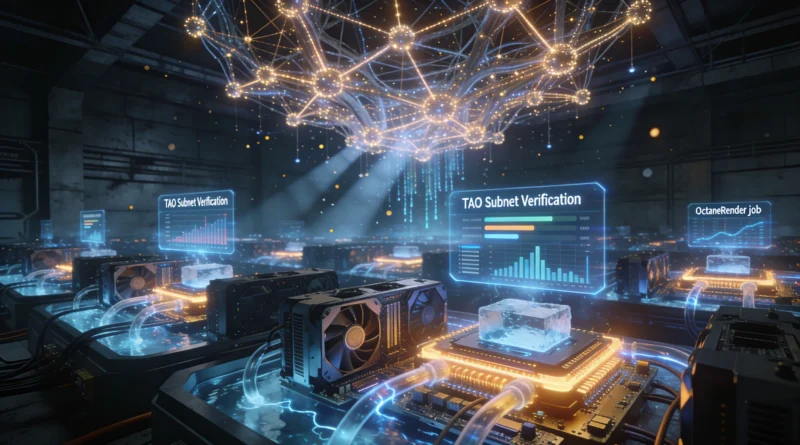
Bittensor functions as a decentralized marketplace for intelligence. However, as of March 2026, the network is undergoing a “Purge.” Early subnets that focused on low-value tasks (like simple image generation) are being outcompeted by subnets dedicated to Protein Folding and Predictive Financial Modeling.
- The Moat: The Yuma Consensus mechanism ensures that only the most accurate AI models receive TAO rewards.
- The Critical Friction: The network still faces high “Noise-to-Signal” ratios. Smart money in 2026 isn’t just buying TAO; they are identifying which specific subnets hold the most valuable data sets.
3. Render (RNDR): Capturing the “Spatial Compute” Overflow
If Bittensor is the brain, Render is the visual cortex. With the explosion of Apple’s Vision Pro 3 and the Meta Reality ecosystem in early 2026, the demand for spatial rendering has surpassed the capacity of centralized studios.
The Nvidia Blackwell Synergy: Contrary to the belief that Nvidia’s new B200 chips would kill decentralized rendering, they have actually accelerated it. As Nvidia prioritizes “Enterprise Training” for trillion-parameter models, the “Creative Rendering” market has been left behind. Render (RNDR) has effectively captured this multi-billion dollar niche, allowing creators to access thousands of idle GPUs globally for a fraction of the cost of a centralized render farm.
4. Hardware Catalysts: The HBM4 and Blackwell Factor
The strength of the AI infrastructure sector is anchored in the Physical Semiconductor Supply Chain.
- HBM4 Memory Chips: The recent mass-shipment of HBM4 (High Bandwidth Memory) from Samsung and SK Hynix in February 2026 has allowed decentralized nodes to handle much larger models than previously possible.
- The Connection: As the hardware layer scales, the decentralized software (DePIN) must scale to match it. This creates a fundamental “Floor Price” for compute tokens based on the cost of the underlying electricity and silicon.
5. The “Agentic Economy” Thesis: Machines as Primary Consumers
The most significant shift in 2026 is the transition from a human-centric internet to an Agentic Economy. We are no longer the primary users of digital assets; AI Autonomous Agents are.
An AI agent operates on pure logic and necessity. To function, these millions of agents require a constant “diet” of two specific resources:
- High-Quality, Verified Data: Facilitated by Bittensor (TAO) subnets.
- GPU Processing Power: Provisioned by Render (RENDER) and other DePIN networks.
The Supply Shock Mechanic:
Unlike human traders who panic-sell during Fed rate hikes, an AI agent’s demand for compute is constant. In early 2026, we are seeing the first signs of a “Compute Supply Shock.” As the number of active agents surmounts the 100-million mark, the decentralized networks are being drained of available GPUs faster than new nodes can be onboarded. This creates a natural price floor for TAO and RENDER that is independent of retail speculation.
6. Comparative Analysis: Resilience vs. Traditional Crypto
When we analyze the performance of AI-centric assets against traditional market benchmarks in this March cycle, the results are statistically undeniable.
| Asset Category | Value Driver (2026) | Macro Correlation | 2026 Resilience Score |
| Traditional Crypto (BTC/ETH) | Global Liquidity / Fed Policy | High | 7/10 |
| AI Infrastructure (TAO/RENDER) | GPU Demand / M2M Economy | Very Low | 9/10 |
| Semiconductor Stocks (NVDA) | Production Capacity | Moderate | 8/10 |
The “Hidden Friction” (Critical Audit)
However, as your critical analyst, I must highlight the systemic failures. Bittensor still struggles with “Incentive Gaming,” where sophisticated miners use synthetic data to “trick” validators for TAO rewards. Similarly, Render is facing a “Latency War” against centralized giants like AWS. For the DePIN thesis to fully mature by 2027, these networks must move from “experimental” to “enterprise-grade” reliability.
7. Strategic Integration: The RWA and Institutional Link
This shift toward AI utility is not happening in a vacuum. It is deeply linked to the Tokenization of Real-World Assets (RWA).
Institutional giants are no longer just looking at tokens as “digital gold”; they are viewing them as the infrastructure rails for the future financial system. As we discussed in our recent report on The Institutional Accumulation Phase: Analyzing Goldman Sachs’ Crypto Strategy in 2026, banks are positioning themselves to own the “Digital Utility Grid.”
Smart money is rotating into AI compute as the ultimate “Safe Haven” because, in a world of inflation and volatility, Compute is the only currency that never loses its utility.
8. Final Verdict: The Machine-to-Machine Era
In my professional opinion, the AI sector represents the first “Industrial Phase” of the digital asset market. We have successfully moved away from the era of speculative memecoins and into the era of Industrial Utility-Coins.
The charts for March 2026 are clear: when volatility hits, assets with real-world utility like TAO and RENDER are the first to recover. This is the “Signal” in the “Noise.” Owning the infrastructure layer today is akin to owning the oil fields at the dawn of the combustion engine.
Key Takeaways for March 2026:
- Monitor the “Agent Count”: The growth of autonomous agents is a more accurate predictor of TAO price than any MACD indicator.
- Network Latency: Watch for Render’s upcoming “Solana Subnet” updates; throughput is the only metric that matters for enterprise adoption.
- Context Matters: For a deeper understanding of how this compute power is being utilized in the current cycle, refer to our The 2026 Crypto Strategy Manifesto: Alpha RWA Edition.