RWA Tokenization Explained: How WLFI and Securitize Are Transforming Luxury Real Estate
Last Audit: March 3, 2026 (Post-World Liberty Forum Analysis)
Editor’s Note: This article is part of our “Market Infrastructure Series” and is strictly for educational and informational purposes. It does not constitute financial, legal, or investment advice. Our goal is to analyze the technical and economic structures of emerging RWA protocols.
The Great Migration: From Speculation to Yield
As of March 2026, the “Tokenization of Everything” is no longer a slide in a VC deck; it is a multi-billion dollar migration of value. While the retail crowd spent 2024 chasing ephemeral meme coins, institutional capital spent that time building the rails for Real World Assets (RWA).
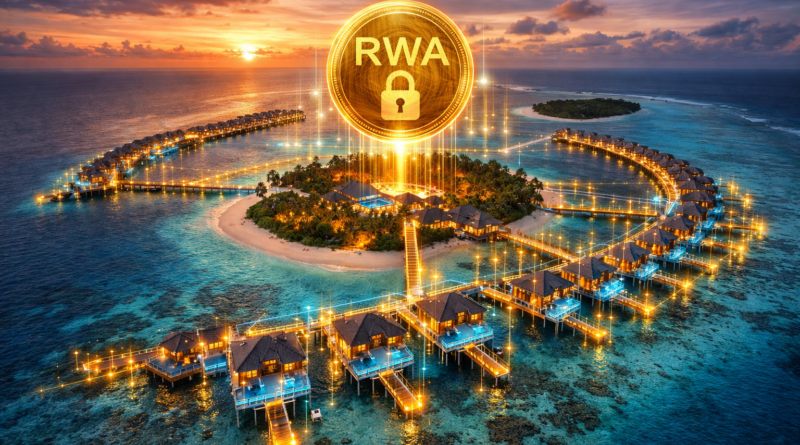
The announcement at the World Liberty Forum on February 18, 2026, held at Mar-a-Lago, marked the most significant institutional validation of this narrative to date. World Liberty Financial (WLFI) has partnered with Securitize the kingmaker of on-chain securities to tokenize the loan revenue of the Trump International Hotel & Resort in the Maldives.
This is not just another real estate deal. It is a fundamental restructuring of how “Cyborg Investors” access premium yield through private debt, bypassing the legacy banking bottlenecks that have historically gatekept the world’s most lucrative developments.
1. The Anatomy of the Deal: Loan Revenue vs. Direct Ownership
To understand why this partnership is a watershed moment, we must first dispel a common 2024 misconception. Most investors hear “tokenized real estate” and assume they are buying “fractional bricks.” In the case of WLFI and Securitize, the reality is far more sophisticated and institutionally aligned.
The “Loan Interest” Model
Investors are not buying equity in the Maldives resort. Instead, they are buying Loan Revenue Interests.
- The Structure: DarGlobal (the developer) secures a loan to build the ultra-luxury resort, featuring 100 beach and overwater villas scheduled for completion in 2030.
- The Tokenized Asset: Securitize wraps the interest payments of this loan into digital tokens.
- The Investor Role: As a token holder, you are essentially acting as the bank. You receive a structured fixed yield sourced directly from the debt service of the project.
This distinction is critical for risk management. Debt sits higher in the capital stack than equity. By tokenizing the loan rather than the property itself, WLFI provides a more stable, predictable yield profile exactly the type of “Alpha RWA” we analyzed in our The 2026 Crypto Strategy Manifesto.
2. Key Players: The RWA Power Grid
In 2026, a project is only as strong as its compliance layer. The WLFI-Securitize alliance brings together three distinct pillars of the new financial order:
World Liberty Financial (WLFI): The Narrative Engine
Led by the Trump family, WLFI is the bridge between traditional high-net-worth circles and the decentralized frontier. Their strategy is clear: use a globally recognized brand to onboard “dark” institutional capital into the DeFi ecosystem. However, a critical piece of the puzzle is DT Marks DEFI LLC, the entity that receives 75% of the net income from token sales. This transparency is vital; in 2026, “Sovereignty” means knowing exactly where the fees are flowing.
Securitize: The Infrastructure Kingmaker
With over $4B in assets under management (AUM) and the backing of BlackRock, Securitize is the only platform that has successfully navigated the SEC’s “Decentralization Scores.” By utilizing Securitize’s rails, the Maldives project enters a regulated secondary market, solving the liquidity trap that has plagued luxury real estate for decades.
DarGlobal: The Physical Anchor
Based in the UK and listed on the LSE, DarGlobal provides the “Real” in Real World Assets. Their 2030 vision for the Maldives isn’t just a rendering; it is a $500M+ physical asset that provides the collateral for the on-chain tokens.
3. Tactical Matrix: RWA Evolution (2024 vs. 2026)
| Feature | Legacy Real Estate (2024) | WLFI/Securitize Model (2026) |
| Asset Type | Fractional Equity (Bricks) | Loan Revenue Interests (Debt) |
| Minimum Entry | $50,000 – $1M+ | Fractional (Accredited Only) |
| Settlement | T+30 to T+90 Days | Atomic / Instant |
| Reporting | Paper-based 1099s | Automated 1099-DA via Agentic AI |
| DeFi Utility | None (Static) | Collateral for WLFI Markets |
The Compliance Necessity
As we enter the mid-2026 cycle, the most dangerous mistake an investor can make is ignoring the “Compliance Shadow.” Managing these high-yield tokens requires a system that can handle the IRS’s new demands. For a deep dive into how to manage these specific tax liabilities, see our guide on Wealth Management 3.0: Navigating the 1099-DA Transition.
4. The “Toll-Gate” Economy: Understanding DT Marks DEFI LLC
As a critical analyst, we must look beyond the glossy renderings of Maldivian overwater villas. The true innovation and potential friction point of the WLFI model lies in its profit-sharing architecture.
A key entity in this structure is DT Marks DEFI LLC, an affiliate linked directly to the Trump family. According to the March 2026 disclosure updates, this entity is entitled to approximately 75% of the net token sale proceeds after expenses.
- The Analyst’s Take: In 2026, WLFI functions as a “Toll-Gate” for institutional DeFi. They are not just developing a hotel; they are monetizing the brand’s ability to pull liquidity on-chain. Investors must realize that WLFI’s primary revenue is generated at the moment of issuance, regardless of when the first guest checks into a villa in 2030. This is the ultimate “Cyborg” realization: in the RWA era, the financial wrapper is often more profitable than the physical asset.
5. Tactical Challenges: The “Development Lag” and Liquidity Risk
While the partnership with Securitize provides a regulated framework, it does not eliminate the inherent risks of tokenizing a project that is still four years away from completion.
The Development Lag
Traditional RWA tokenization usually focuses on completed, income-generating assets (like an office building with existing tenants). The Maldives project tokenizes the development phase itself.
- The Risk: If construction faces delays beyond 2030 a common occurrence in luxury hospitality the “Fixed Yield” promised to investors depends entirely on the developer’s (DarGlobal) ability to service the loan from other revenue streams.
- Secondary Market Friction: Despite Securitize’s secondary market infrastructure, these tokens lack the “Instant Exit” of a liquid asset like Bitcoin. If you need to exit a $5M position in 2027, you are selling a “future promise” of a hotel that doesn’t yet exist. Expect liquidity discounts of 15-25% in high-volatility environments.
6. The “Sovereign” Utility: WLFI Markets as a Collateral Hub
One of the most aggressive updates for March 2026 is the integration of these RWA tokens into WLFI Markets.
For the first time, verified accredited investors can use their Maldives Loan Tokens as collateral to borrow stablecoins. This creates a recursive liquidity loop:
- You hold the RWA token (earning a fixed yield).
- You collateralize the token in the WLFI protocol.
- You borrow stablecoins to re-invest in other “Alpha RWA” opportunities.
This “Recursive Yield” strategy is exactly what separates the top 1% of on-chain managers from the retail herd. However, as we discussed in ourLedger vs. Trezor (2026) Audit, managing these complex collateralized positions requires hardware-level security to prevent “drainer” smart contracts from accessing your main wealth vault.
7. Final Verdict: A Watershed Moment for Private Credit
The WLFI-Securitize partnership is proof that the “Great Divide” in finance is closing. By tokenizing the loan revenue of a $500M+ luxury resort, the industry has proven that blockchain can solve institutional access problems. As the RWA sector matures, the key to success is not chasing the brand, but understanding the underlying compliance infrastructure.
Key Takeaways for March 2026:
- Verify the Basis: Don’t let the 1099-DA catch you off guard. Ensure your Agentic AI is tracking the purchase price of these tokens from day one.
- Know the Structure: You are a lender, not an owner. Your upside is capped at the fixed yield, but your downside is protected by the collateralized debt structure.
- Embrace the Cyborg Mindset: Stop looking at the “Trump” brand and start looking at the Securitize infrastructure. Compliance is the only thing that makes this asset tradable in the long run.
The RWA migration is here. The question is: are you the bank, or are you the exit liquidity?