Digital Asset Custody 2026: A Technical Audit of Ledger and Trezor Hardware Security
Last Audit: March 3, 2026
Quick Disclosure: This technical comparison is for informational purposes only and does not constitute financial advice. We have no financial affiliation with Ledger SAS or SatoshiLabs. Cold storage is the only defense against exchange insolvency, but it requires strict operational discipline.
The cryptocurrency landscape has matured significantly, but the scars of the past from the FTX collapse to the 2025 liquidity crunches remain. As we analyzed in our MEXC Global Infrastructure Audit 2026, while centralized platforms are essential for execution and finding the next 100x alpha, they should never be treated as vaults.
To achieve true financial sovereignty, transitioning wealth into Cold Storage is no longer a suggestion; it is a mandatory protocol. However, in 2026, the choice between Ledger and Trezor is no longer just about “buttons vs. touchscreens.” It is a fundamental choice between Integrated Ecosystems and Open-Source Purism.
1. The 2026 Hardware Landscape: Beyond the Nano and Model T
If you are still looking at the original Nano X or the Model T as the “top tier,” your security model is outdated.
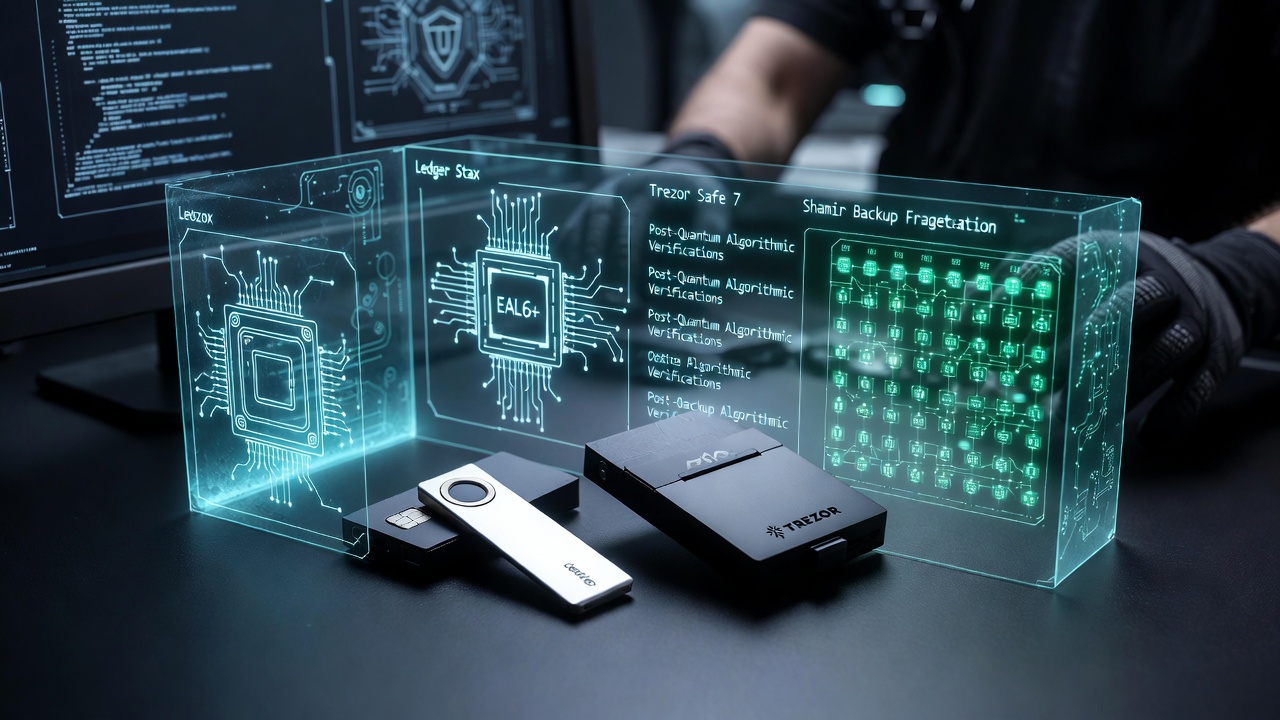
- Ledger has doubled down on high-end hardware with the Ledger Stax and the Ledger Flex, featuring E-ink displays and EAL6+ certified secure elements.
- Trezor has responded with the Trezor Safe 7, their first “Quantum-Ready” device that finally bridges the gap between open-source transparency and physical chip security.
2. Ledger: The King of Convenience and the “Trust Gap”
Ledger remains the most recognized name in the industry, but its path in 2026 is defined by a paradox: superior usability vs. a shifting trust model.
The “Ledger Recover” Reality
The 2023-2024 controversy surrounding Ledger Recover (a firmware-based seed fragment export service) changed the industry forever. As an analyst, I must be blunt:
- The Good: It provides a safety net for retail users who fear losing their 24 words.
- The Critical: It proved that Ledger’s firmware is technically capable of accessing the seed if authorized. For the “Don’t Trust, Verify” crowd, this shifted Ledger from a “Zero-Knowledge” device to a “Trust-the-Corporation” device.
The Ecosystem Advantage
Despite the controversy, Ledger Live is the most polished app in the space. It allows for seamless NFT management, native staking, and direct interaction with the AI and DePIN assets we highlighted in our 2026 Crypto Strategy Manifesto.
- Secure Element (CC EAL6+): Their proprietary chip remains the gold standard against physical tampering (side-channel attacks).
- Mobile Sovereignty: With Bluetooth and NFC integration in the Stax and Flex models, Ledger is the only viable option for the mobile-first “Cyborg Trader.”
3. Trezor: The Open-Source Evolution and Quantum Defense
SatoshiLabs (Trezor) has spent 2025-2026 reinventing itself. They have moved past their historic “no secure element” stance to create a hybrid model that purists love.
The Dual-Chip Architecture
The Trezor Safe 7 features a dual-chip setup:
- TROPIC01: A fully transparent, auditable secure element designed by Trezor themselves.
- EAL6+ Secondary Element: An NDA-free chip that provides physical protection without compromising the open-source ethos.
Quantum-Readiness
In 2026, the threat of AI-driven quantum computing to traditional Elliptic Curve Cryptography is a growing concern. Trezor is the first to implement Post-Quantum Cryptography in its boardloader. This means the Safe 7 can verify its own firmware updates even in a world where today’s encryption is broken.
Analyst’s Note: If you are holding Bitcoin for a 10-year horizon, Trezor’s commitment to “Quantum-Readiness” and 100% open-source code provides a “Sleep-Well-at-Night” factor that Ledger’s closed-source model cannot match.
4. Direct Comparison: The 2026 Flagships
To make an informed decision in this supercycle, we must look at the raw specifications. The days of “cheap” security are over; in 2026, you are investing in the long-term integrity of your capital.
| Feature | Ledger Stax / Flex | Trezor Safe 7 |
| Primary Chip | Proprietary CC EAL6+ | Dual Chip (TROPIC01 + Optiga) |
| Source Code | Closed Source (Secure Element) | 100% Open Source |
| Display | Curved E-ink (Touch) | OLED Color (Touch) |
| Connectivity | Bluetooth / NFC / USB-C | USB-C / Encrypted Bluetooth |
| Backup Protocol | Ledger Recover (Cloud Optional) | Shamir Backup (Multi-share) |
| Special Feature | Native NFT & DePIN Dashboard | Post-Quantum Defense Layer |
5. The “Cyborg Strategy”: Why You Need Both
As a critical analyst, I don’t recommend brand loyalty; I recommend functional redundancy. In 2026, the most secure portfolios don’t rely on a single device. They use a split-custody model:
- The “Active” Ledger: Use a Ledger Stax for your daily operations. This is where you keep the liquidity for the next AI agent rollout or the RWA tokens we discussed in our Institutional Accumulation Phase Report. The Bluetooth convenience allows you to react to market volatility in seconds without needing a desktop.
- The “Sovereign” Trezor: Use a Trezor Safe 7 for your “Generational Wealth.” This device should stay offline, in a physical safe. By using Shamir Backup, you can split your recovery phrase into 5 fragments and store them in different geographic locations. This eliminates the “Single Point of Failure” risk.
6. Operational Hygiene: The 2026 Security Mandates
A hardware wallet is not a magic shield; it is a tool. If the user is compromised, the device is irrelevant. Follow these non-negotiable rules for March 2026:
- The “Air-Gap” Illusion: Even Bluetooth wallets are “offline” because the private keys never touch the internet. However, always verify the transaction details on the device’s screen, not your phone. The screen of your Ledger or Trezor is the only “Source of Truth.”
- Zero Digitization: Never take a photo of your seed phrase. In 2026, AI-driven malware can scan your cloud photos and recognize 24-word patterns in milliseconds. Use titanium plates for physical backups.
- Supply Chain Integrity: Buy directly from the manufacturer. As we’ve seen in recent supply chain attacks, 3rd party resellers can pre-configure devices with hidden backdoors.
7. The Future of Custody: RWA and Institutional Standards
The shift toward cold storage is being accelerated by the “Institutionalization of Crypto.” As companies like Goldman Sachs and BlackRock move deeper into the space a trend we analyzed in our Goldman Sachs 2026 Strategy Audit the standards for custody have risen.
Institutional-grade security is no longer reserved for banks. With the Trezor Safe 7’s quantum resistance and Ledger’s EAL6+ architecture, retail investors now have access to the same level of protection as a multi-billion dollar hedge fund.
Final Verdict: Atoms over Promises
In 2026, the ultimate luxury is Certainty. Centralized exchanges are excellent for trading, but they are built on “promises to pay.” A hardware wallet is built on “mathematical proof of ownership.”
- Choose Ledger if you are an active participant in the Web3 ecosystem, trading DePIN, NFTs, and AI subnets daily.
- Choose Trezor if you are a Bitcoin maximalist or a privacy advocate who demands 100% transparency and protection against future quantum threats.
The 2026 Commodities Supercycle and the AI revolution are creating unprecedented wealth. Don’t let that wealth vanish because you were too lazy to spend $150 on a cold wallet. Own your keys, or own nothing.
Independent Security Disclosure
- Non-Affiliation: We are not sponsored by Ledger or Trezor. Our reviews are based on technical audits and stress-testing in real-market conditions.
- Risk Warning: Hardware wallets do not protect you against “rug pulls” or malicious smart contracts. Always audit the dApps you interact with.
- Educational Purpose: This content is for informational purposes only. Consult with a cybersecurity professional for large-scale institutional custody setups.