
The 2026 Crypto Strategy Manifesto: Tactical Execution, Macro Forensics, and the Cyborg Mindset
The financial playbook of 2024 is officially dead. As we enter March 2026, the convergence of Agentic AI, Tokenized Real World Assets (RWA), and the IRS 1099-DA compliance shadow has created a “Great Divide” in the markets. On one side, the retail herd is still following obsolete, static advice; on the other, the Cyborg Investors are utilizing a unified tactical framework to outperform the machines.
To protect and grow wealth today, we must dismantle the four pillars of legacy retail strategy and replace them with a system built for the era of high-frequency, autonomous finance.
1. The Death of Blind DCA: Why “Consistency” is the New Exit Liquidity
Historically, Dollar Cost Averaging (DCA) was the holy grail for the retail investor. The pitch was simple: buy the same amount regardless of price. In 2026, this is a strategic suicide mission.
Institutional AI agents now map out retail liquidity clusters with terrifying precision. If you buy on a fixed calendar date (the 1st or 15th of every month), you are providing a predictable liquidity event for bots to front-run. They detect the massive inflow of retail orders and “sweep the floor” milliseconds before your order hits the exchange, leaving you with a local price peak.
The 2026 Evolution: Signal-Based Entry (SBE)
Instead of a calendar, the professional investor uses Liquidity Oracles. An SBE approach ignores the date and monitors the Net Liquidity Delta.
| Feature | Legacy DCA (2024) | Tactical SBE (2026) |
| Execution | Time-Dependent (Fixed) | Event-Dependent (Signal) |
| Cost Basis | Market Average | Volatility-Optimized |
| Risk | High Front-running risk | Low Slippage |
| Tools | Exchange Recurring Buy | Agentic Triggers / Smart Contracts |
Analyst’s Take: Buying blindly on a fixed date is a 20th-century habit in an AI-driven market. If your strategy doesn’t account for institutional liquidity sweeps, you aren’t an investor you’re a donor. The “set it and forget it” era has been replaced by “program it and monitor it”.
2. Macro Forensics: The CPI is a Lagging Ghost
Most retail traders are still glued to their screens waiting for the Bureau of Labor Statistics to release the Consumer Price Index (CPI). In 2026, this is equivalent to checking the weather by looking at a photo from last week.
The market now prices in inflation 48 to 72 hours before the official release. The “Macro Lag” is no longer a few minutes; it’s a few days. How is the smart money beating the news? Through Alternative Data Streams:
- On-chain Stablecoin Supply Ratio (SSR): Measuring the “dry powder” sitting on exchanges in real-time.
- Real-time Supply Chain Oracles: Monitoring shipping costs in decentralized logistics networks like DePIN Networks.
- AI Sentiment Aggregators: Processing millions of social data points to predict the “narrative shift” before it hits Bloomberg.
What I Really Think: The CPI is a theater production designed to keep the masses distracted. If you’re waiting for the TV to tell you what inflation did last month to make a decision today, you’ve already lost. In 2026, macroeconomics is measured in milliseconds via on-chain liquidity flows, not in government PDFs.
3. The Liquidity Gap: Understanding Institutional “Sweeps”
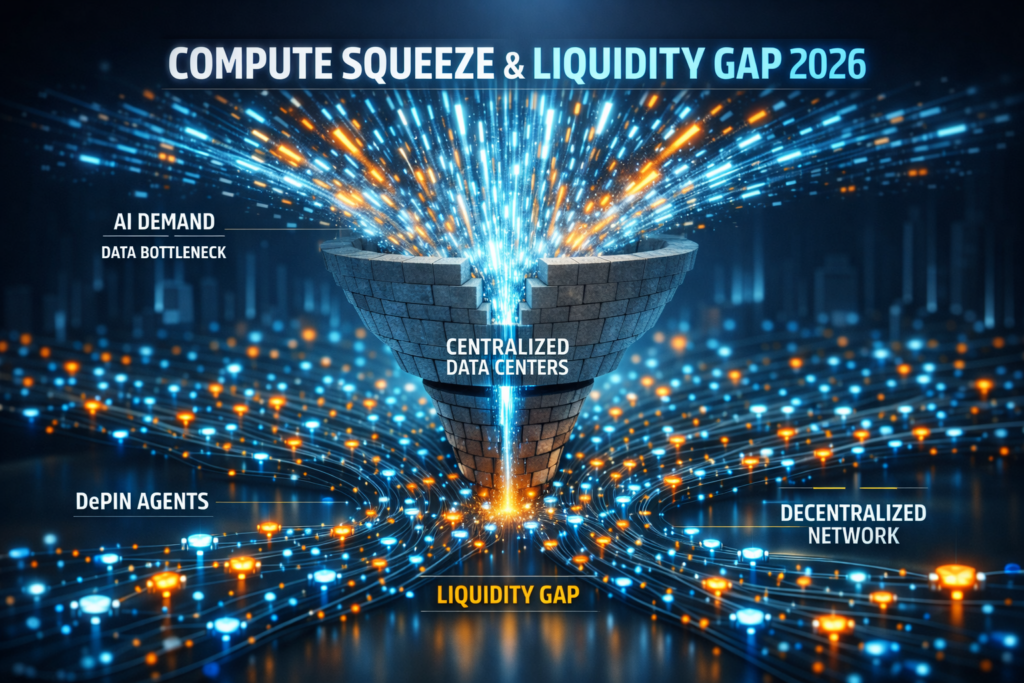
In 2026, the concept of “Support and Resistance” has been replaced by Liquidity Gaps. Algorithms don’t look at chart patterns; they look for areas where retail stop-losses are clustered.
When you place a “Stop Loss” on a centralized exchange, you are essentially publishing your “Pain Point” to the market makers. In high-volatility events, we see Liquidity Sweeps where the price is intentionally pushed down to trigger these stops, creating a cascade of sell orders that the institutions buy up at a discount.
How to combat this:
- Mental Stops with Agentic Triggers: Use an autonomous agent that only executes the sell order when certain conditions are met, rather than leaving a limit order on the books.
- Volatility Buffers: In 2026, a 5% stop-loss is suicide. Volatility-adjusted stops (using ATR – Average True Range) are the only way to stay in the game.
4. Tactical Hedging: Beyond Gold and the “Safety” of Cash
The concept of “Hedging” has undergone its most radical transformation since the 1970s. Moving into Cash (USD) is no longer a “risk-off” move; it’s a guaranteed loss of purchasing power against the computational economy. Furthermore, the launch of FedNow and Global CBDCs has made privacy in cash positions a thing of the past.
In 2026, the ultimate financial bunker has evolved beyond physical gold into Yield-Bearing RWA (Real World Assets). When crypto markets turn toxic, strategic capital no longer exits to traditional bank accounts; instead, it rotates into Tokenized T-Bills offering 5%+ on-chain yields with instant settlement, or Fractionalized Private Credit for non-correlated institutional returns. Furthermore, yield-bearing stablecoins like USDY or USDe now allow investors to distribute income directly to their wallets without leaving the blockchain ecosystem. True tactical hedging in 2026 is only effective if your assets remain liquid and programmable if your capital is trapped in a legacy bank with a 3-day withdrawal delay, you aren’t hedged; you’re vulnerable.
Tactical Insight: A hedge in 2026 is only effective if it is liquid and programmable. If your capital is locked in a physical vault or a legacy bank with a 3-day withdrawal delay, you are not hedged; you are trapped.
5. Psychological Warfare: The Death of the “Diamond Hands” Myth
“Diamond Hands” is a marketing term invented to keep retail investors from selling while institutions exit their positions. In 2026, holding an asset that is fundamentally failing due to “loyalty” or “community” is a psychological disorder, not a virtue.
The market is now dominated by Agentic AI. These bots don’t have fear. They don’t have “hope.” They follow code. To compete, you must adopt a Cyborg Mindset.
The “Human Tax” on Your Portfolio
The ‘Human Tax’ on your portfolio is a measurable 12-18% performance drag caused by primitive cognitive biases. This drag manifests primarily through the ‘Wait and See’ Bias, where traders hesitate despite clear signals, and Revenge Trading, an emotional attempt to recover losses from failed positions. Perhaps most damaging is Ego-Holding the refusal to cut a loss simply because it requires admitting a mistake. In an era dominated by emotionless Agentic AI, competing requires a Cyborg Mindset that prioritizes automated code over human ‘hope’.
6. The Compliance Shadow: IRS 1099-DA and the Cost-Basis War
As we enter march 2026, the IRS 1099-DA is no longer a threat it is a reality. Centralized exchanges are now reporting every gross proceed to the government.
For the first time, the “Cost Basis War” is in full swing. If you have moved assets between self-custody wallets and exchanges, the 1099-DA you receive will likely show a $0 cost basis, leading to massive, incorrect tax bills.
Strategic Compliance Checklist:
- Wallet-Level Tracking: The IRS has eliminated the “universal method.” You must track cost basis per wallet.
- Automated Reconciliation: Use tools that integrate with Wealth Management 3.0 to document every swap in real-time.
7. The Layer 2 Fragmentation: Why Mainnet is the New “Deep Storage”
In 2026, the Ethereum Mainnet has become a settlement layer for whales and institutions. If you are a retail investor still paying $50 gas fees to swap on L1, you are burning capital for no reason.
The strategy has shifted to L2 Interoperability. However, this has created a new risk: Liquidity Fragmentation. Assets on Base, Arbitrum, and Optimism don’t always trade at the same price.
- The Opportunity: Cross-chain arbitrage agents.
- The Risk: Bridge vulnerability. In 2026, the safest way to move “wealth” is through Native Mint/Burn protocols (like Circle’s CCTP), not third-party wrapped bridges.
8. On-Chain Security: The Rise of the “Honey-Pot” AI
As AI helps us trade, it also helps hackers. In 2026, we are seeing Generative Scams smart contracts that look perfect to a human auditor but contain “logic bombs” that only trigger under specific liquidity conditions.
Survival Rules for 2026:
- Simulation is Mandatory: Never sign a transaction without a “Simulation Layer” (like Firewall or Blockaid) showing exactly what leaves your wallet.
- Isolated Execution Environments: Use separate wallets for “Trading Agents” and “Long-term Storage.” Never let an AI agent have “Unlimited Approval” on your main wealth vault.
9. The Rise of the Agentic Economy: KYA is the new KYC
We are moving from “Know Your Customer” to “Know Your Agent” (KYA). In 2026, your trading bot is your representative in the market. Agents are now sovereign economic actors capable of managing wallets and executing complex multi-step strategies on networks like Base or Solana.
These agents are currently driving record-breaking protocol fees. If you aren’t utilizing an agent to monitor your “stop-losses” or “yield-compounders,” you are paying an invisible tax on your time and capital.
10. Final Verdict: The Unified Theory of Wealth Protection
Consolidating these pillars DCA, Macro, Hedging, and Psychology is not just an editorial choice; it’s a strategic necessity. You cannot have a good entry if you don’t understand the environment. You cannot protect that entry if you don’t have a bunker. And you cannot do any of it if your brain is sabotaging your decisions.
In 2026, the winner is not the one with the best “feeling,” but the one with the most robust Execution Stack. Stop trading like it’s 2024. Your old articles are history; this manifesto is your new reality.