
Strategic Crypto Allocation 2026: An Analytical Audit of Portfolio Efficiency and Institutional Risk
The global financial landscape of 2026 is no longer debating the validity of digital assets; it is optimizing their integration. Cryptocurrency has transitioned from a speculative “side bet” to a core component of modern asset allocation. However, as the asset class matures, the simplistic advice of “just buy some Bitcoin” has become obsolete.
A professional portfolio in 2026 requires a forensic understanding of how decentralized assets interact with traditional equity and fixed-income markets. Diversification is not merely about owning multiple assets; it is the mathematical process of reducing the “variance” of your wealth while capturing asymmetric upside. In this comprehensive audit, we define the frameworks required to navigate the current liquidity regime without compromising long-term solvency.
1. The Institutional Normalization of 2026
By 2026, the arrival of Spot ETFs for Bitcoin and Ethereum, combined with the implementation of the GENIUS Act in the United States, has altered the DNA of crypto volatility. We are no longer in the “wild west” era of 80% drawdowns driven by retail panic.
- Institutional Dominance: Over 70% of global wealth managers now include digital assets in their core allocation models. This shift has led to “deferred volatility,” where price corrections are shallower but more prolonged due to institutional rebalancing cycles.
- The New Correlation Profile: Historically, Bitcoin was seen as uncorrelated to stocks. In 2026, the data shows a more nuanced reality. While Bitcoin’s correlation with the S&P 500 has stabilized around 0.28, its correlation with Global M2 Liquidity is nearly 0.54. This confirms that crypto is the ultimate “liquidity sponge,” making it a vital hedge against monetary debasement rather than just a tech play.
- Infrastructure as an Asset: The rise of DePIN: The Critical Convergence of AI and Infrastructure has introduced a new sub-sector that behaves differently from traditional tokens, offering rewards based on physical utility rather than pure market sentiment.
2. Defining Your Risk Architecture: The Three Tiers
Before deciding on a percentage, an investor must define their Max Drawdown Tolerance. In 2026, we categorize allocations into three professional tiers based on their impact on the total portfolio’s Sharpe Ratio.
Tier 1: The Systematic Hedge (1% to 4%)
This is the “Institutional Baseline.” It is designed for those who prioritize capital preservation but recognize the risk of having 0% exposure to the fastest-growing asset class in history.
- Impact: At this level, a 50% crash in crypto only reduces the total portfolio by 0.5% to 2%. It is mathematically “safe.”
- Objective: Capture the Convexity of Bitcoin. Even a 2% allocation can significantly boost overall returns if Bitcoin hits its 2026 price targets of $150,000+, without risking the investor’s lifestyle.
Tier 2: The Optimized Growth Model (5% to 12%)
This is the “Modern Balanced” approach. Data from 2025-2026 indicates that this range optimizes the Sharpe Ratio (the measure of return per unit of risk).
- Impact: Crypto begins to meaningfully influence the portfolio’s performance. During bull markets, this tier can double the annual returns of a traditional 60/40 portfolio.
- The Requirement: At this level, passive holding is dangerous. Investors must employ a Rebalancing Strategy to lock in gains and prevent “concentration creep,” where crypto accidentally grows to 30% of the portfolio.
Tier 3: High-Conviction Tactical (15% to 25%+)
This tier is reserved for “Crypto-Native” investors or industry professionals with high income stability and a time horizon exceeding 15 years.
- Impact: High volatility is guaranteed. The portfolio will experience double-digit swings monthly.
- The Security Mandate: Once an allocation enters this tier, the “Exchange Risk” becomes a systemic threat to your net worth. It is mandatory to move assets into self-custody. As we explored in our Tangem Wallet Review, choosing between card-based NFC security or traditional USB wallets like Ledger is a critical operational decision for Tier 3 investors.
3. Asymmetric Returns vs. The “Gambler’s Fallacy”
A common mistake in 2026 is over-allocating to “Altcoins” in hopes of a 100x return. An analytical audit of the last three cycles shows that 95% of mid-cap tokens fail to reclaim their all-time highs.
Diversification within crypto is just as important as diversification into crypto. A professional 2026 allocation usually follows a 70/20/10 rule:
- 70% Core: Bitcoin (Store of Value) and Ethereum (Productive Capital via Staking).
- 20% Infrastructure: DePIN, AI-Compute, and Layer 2 scaling solutions.
- 10% Speculative: Emerging protocols with high asymmetric potential but zero guarantee of survival.
4. The 2026 Correlation Matrix: Crypto vs. Gold vs. Real Estate
In the current 2026 macro environment, understanding how assets “talk” to each other is vital. The narrative of Bitcoin as “Digital Gold” has faced a brutal reality check this year.
- Gold vs. Bitcoin: While gold has seen a banner year due to sovereign debt concerns, its correlation with Bitcoin has actually decreased to 0.05 (near zero). This means they are not the same trade. Gold is a defensive, non-volatile hedge; Bitcoin is a high-beta liquidity sponge. A truly diversified 2026 portfolio holds both.
- Real Estate and the Liquidity Gap: Real estate remains the ultimate “illiquid” diversifier. However, as property markets face pressure from high interest rates, many high-net-worth investors are using crypto as their “portable equity.”
- Equities (S&P 500): Correlation remains moderate (0.43), primarily because both are driven by global M2 money supply. If the Fed pumps liquidity, both rise; if they tighten, both fall.
Allocation Framework by Investor Archetype
This is the practical “Cheat Sheet” for your readers to identify their ideal percentage based on their financial reality in 2026.
| Archetype | Crypto % | Primary Goal | Recommended Custody | Liquidity Strategy |
| Conservative | 1% – 3% | Fiat Hedge | Spot ETFs / Neobanks | Quarterly Rebalancing |
| Balanced | 5% – 10% | Alpha Generation | Tangem / Cold Storage | 5% Drift Trigger |
| Aggressive | 15% – 25% | Wealth Creation | Ledger / Multi-sig | Monthly Volatility Audit |
| Institutional | 2% – 5% | Risk-Adjusted Return | Regulated Custodians | Daily Algorithmic Shifts |
5. Ethereum and Staking: The New “Digital Bond”
The transition of Ethereum from a speculative token to Productive Capital is the most significant shift in 2026. With over 30% of the total ETH supply now staked, the network has created a native “risk-free rate” for the digital economy.
- The Staking Benchmark: Staking yields are currently hovering between 3.5% and 4.2%. In 2026, this is the benchmark against which all other crypto investments are measured. If a DeFi protocol isn’t offering more than 4%, it is mathematically irrelevant.
- Liquid Staking and Restaking: Protocols like Lido and EigenLayer have turned “staked ETH” into a liquid asset that can be used as collateral. For your allocation, this means ETH is no longer “dead weight” in your wallet; it is an active, yield-generating bond. This makes the DePIN: The Critical Convergence of AI and Infrastructure sector even more attractive, as these networks often use staked assets to secure physical hardware.
6. The Forensic Rebalancing Strategy: Avoiding Concentration Creep
The greatest enemy of a diversified portfolio is its own success. If you start with a 10% crypto allocation and Bitcoin doubles while stocks stay flat, you are now at ~18% exposure. Your risk profile has fundamentally changed without you taking any action.
Professional Rebalancing in 2026:
- The 5% Drift Trigger: Don’t rebalance on a schedule (like “every 6 months”). Rebalance when your crypto allocation “drifts” more than 5% away from its target.
- Tax-Loss Harvesting: Use market dips to “sell and immediate buy-back” (where legal) to lock in tax losses that offset your gains.
- The Off-Ramp Protocol: This is where the strategy meets the bank. Moving large amounts of capital back to fiat is the most dangerous moment for an investor. As we noted in our Analytical Audit of Wise vs. Revolut, neobanks have become the primary gatekeepers of this liquidity. You must have your “liquidation rails” verified and ready before the bull market peak, or your diversification gains will remain trapped on-chain.
7. Final Verdict: The 2026 Diversification Blueprint
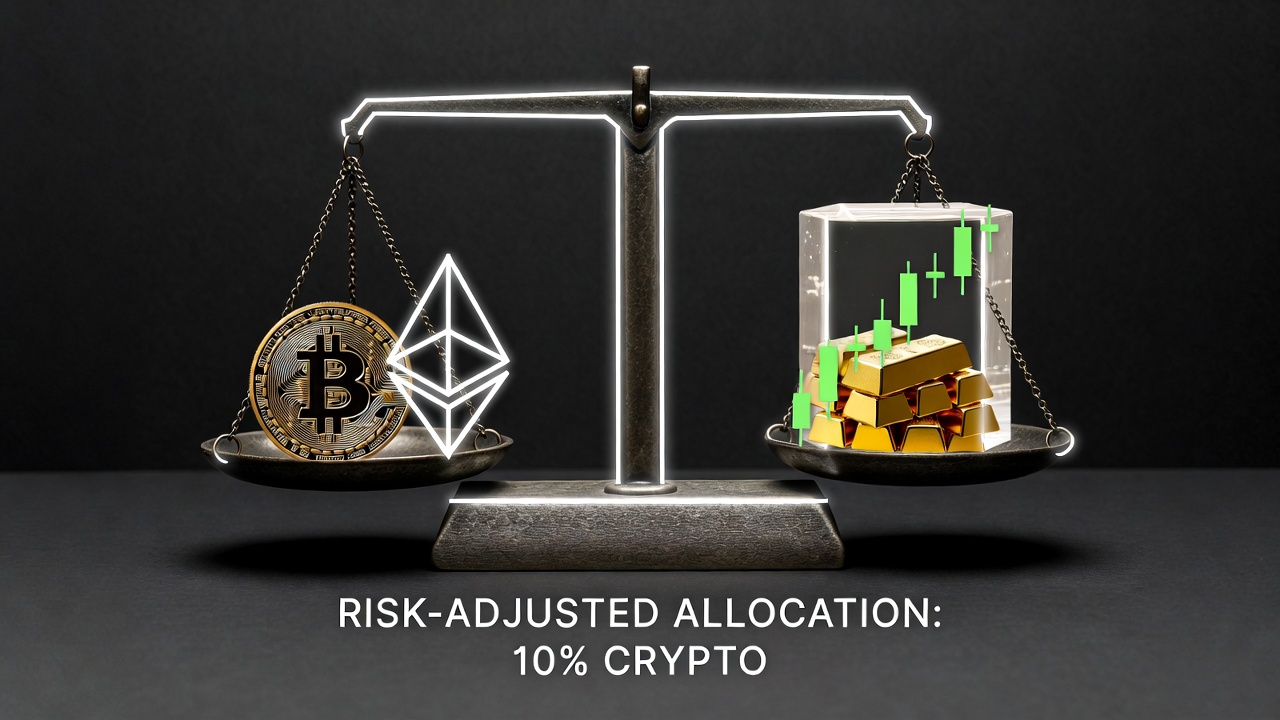
So, what is the final answer? For most investors in 2026, the “Sweet Spot” is 8% to 12%.
This range provides enough exposure to move the needle on your total net worth without causing systemic ruin if the market enters a multi-year “crypto winter.” However, as your net worth grows, the complexity of securing these assets grows with it. A 10% allocation on a $1M portfolio is $100k an amount that requires professional-grade protection.
Whether you choose the simplicity of a card-based system, as discussed in our Tangem Wallet Review, or the traditional USB architecture of Ledger and Trezor, your allocation is only as good as your ability to defend it. In 2026, the ultimate diversifier is not the asset you buy, but the discipline you maintain.