TradingView Pro vs. Free in 2026: Is the ‘Deep Backtesting’ and Volume Profile Worth the Upgrade?
The retail trading landscape has fundamentally shifted. In 2026, we are no longer competing solely against other human traders, but against Autonomous AI Agents and High-Frequency Execution models that react to liquidity shifts in milliseconds. In this environment, your charting platform is not just a visual tool; it is your data terminal.
The question for the modern market participant is no longer just “Free vs. Paid,” but whether your infrastructure—specifically TradingView Pro—provides the structural edge required to interpret the 2026 Silicon Economy.
1. The Death of the “Free Indicator” Era
For years, the Free plan was sufficient for basic RSI or MACD analysis. However, as we analyzed in our deep dive into Monad vs. Berachain: Architectural Supremacy and Liquidity Dynamics, the market has moved toward Liquidity-Centric Trading.
- The Free Limitation: You are restricted to basic technical indicators that are often lagging and insufficient for identifying institutional “Dark Pools” or hidden order blocks.
- The Pro Edge (Volume Profile): The Fixed Range Volume Profile (FRVP), exclusive to paid tiers, is no longer a luxury. In 2026, understanding the Point of Control (POC)—where institutional accumulation actually happens—is the only way to avoid being “exit liquidity” for automated bots.
2. Pine Script v6 and the Deep Backtesting Engine
One of the most significant technological upgrades in early 2026 is the Pine Script v6 integration. While Free users can run basic community scripts, the computational priority for Deep Backtesting is strictly reserved for Pro and higher tiers.
- Historical Data Access: Free plans offer limited historical bars, which is a statistical death sentence for strategy validation. You cannot find “Alpha” on a 3-month dataset.
- Precision and Latency: The Pro “Deep Backtesting” engine allows you to simulate strategies over 20-year datasets with sub-minute precision. If you are developing automated agents to trade the AI Compute Revolution (Bittensor/Render), testing on a limited Free dataset is mathematically irresponsible.
3. Workflow Architecture: Multiple Layouts vs. Cognitive Load
Most traders underestimate the cost of Mental Friction. TradingView Pro allows for multiple chart layouts and synchronized cross-hair tracking across different assets.
- The 2026 Multi-Asset Correlates: Today, you cannot trade Crypto in a vacuum. You must watch the Nasdaq 100, Nvidia’s Volatility (NVX), and U.S. Treasury Yields simultaneously to understand capital rotation.
- The Workflow Gap: Constantly switching tabs on a Free plan creates a “Execution Lag” in human decision-making. Pro’s ability to view 2 to 4 charts in a single window reduces the cognitive load, allowing you to spot inter-market correlations before the price action confirms the move on your main chart.
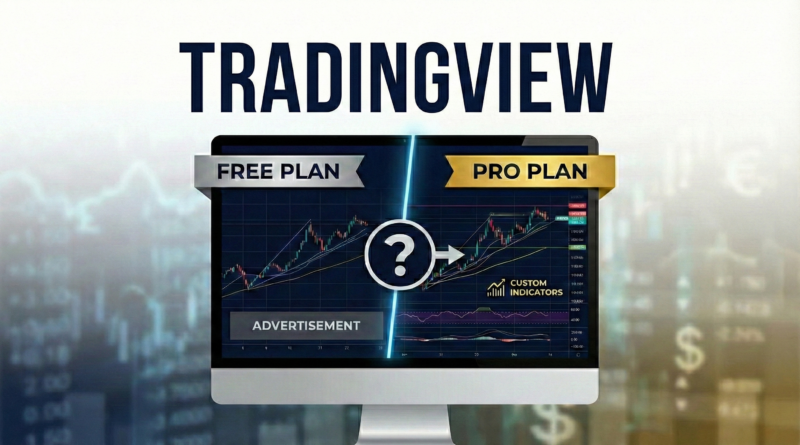
4. Technical Comparison Matrix (2026 Standards)
| Feature | Free Plan (The Observer) | Pro Plan (The Strategist) |
| Data Retention | Limited Bar History | 20-Year Deep Backtesting |
| Advanced Tools | Basic TA Only | Volume Profile / Intraday Replay |
| Execution | Manual / High Friction | Webhook Alerts / Automated Logic |
| Ads/Noise | Ad-supported (Distraction) | Clean Terminal Aesthetic |
| M-to-M Integration | None | Priority Pine Script v6 Execution |
5. Risk Management: The Hidden Cost of Free Alerts
In the 2026 market, volatility is no longer driven by news cycles alone, but by Liquidity Cascades. Relying on the Free plan’s delayed or limited alerts is a form of operational risk.
- The Alert Latency: While TradingView Pro users receive server-side, instantaneous Webhook notifications, Free users often face “Execution Lag.” In a market where AI-Driven Liquidity (Monad) can move 5% in seconds, a 10-second delay in an alert can be the difference between a controlled exit and a liquidated position.
- Automated Logic (Webhooks): One of the most underrated features of the Pro tier is the ability to send alerts directly to automated execution bots via Webhooks. Without this, your strategy remains purely manual—a significant disadvantage in an era of machine-to-machine finance.
6. Trading Psychology: Visual Noise vs. Flow State
A professional trader treats their screen as an operating room. The psychological impact of “Visual Noise” is statistically significant in high-stress environments.
- The Ad-Driven Distraction: The Free plan’s reliance on sidebar advertisements is not just a nuisance; it breaks the “Flow State.” Every distraction increases the probability of an “Error of Execution” (Fat Finger).
- Terminal Aesthetic: Pro tiers offer a clean, dark-mode-optimized terminal aesthetic. In 2026, where the AI Compute Revolution has increased market complexity, a clean workspace is essential for maintaining the mental clarity required to identify structural shifts in the order book.
7. The Verdict: When to Stop Being an “Observer”
A professional trader treats software as an Operating Expense (OpEx), not a cost.
- The Free Plan is for Learning: If you are still mastering the basics of support and resistance, do not pay for Pro. The software won’t fix a lack of discipline or a faulty edge.
- The Pro Plan is for Scaling: If your strategy relies on Volume Profile Analysis, Multi-Timeframe Correlation, or Automated Webhooks, staying on the Free plan is actually costing you money in lost opportunities and slippage.
My Personal Take
In my professional opinion, the “Free” plan is a strategic trap for those trying to scale. In 2026, the market is too fast for manual tab-switching and limited historical data. If you are serious about competing in the Agentic Economy, upgrading to Pro is not about “better signals”—it is about possessing a professional-grade workstation that matches the speed and precision of the institutions.
Master FAQ: TradingView Infrastructure in 2026
1. Does TradingView Pro guarantee better trading results? No. Pro provides the infrastructure for better analysis, but it does not replace the need for risk management and a proven edge.
2. Is Pine Script v6 available for Free users? Yes, but with significant limitations. Free users have lower memory allocation for scripts, which often results in “Calculation Timeout” errors when running complex AI-based strategies.
3. Can I use the Volume Profile on the Free plan? Only in limited community scripts. The Official Fixed Range Volume Profile (FRVP) and the Visible Range Volume Profile (VRVP)—the industry standards for identifying institutional interest—are locked behind paid tiers.